
ParkingMate.ai
A camera-first web app for reading Melbourne parking signs. I designed and built it for drivers who need to make sense of several rules before leaving the car.
Can I park here?
Photograph the whole sign and get a reading in English or Chinese while you’re still at the kerb.
Try ParkingMate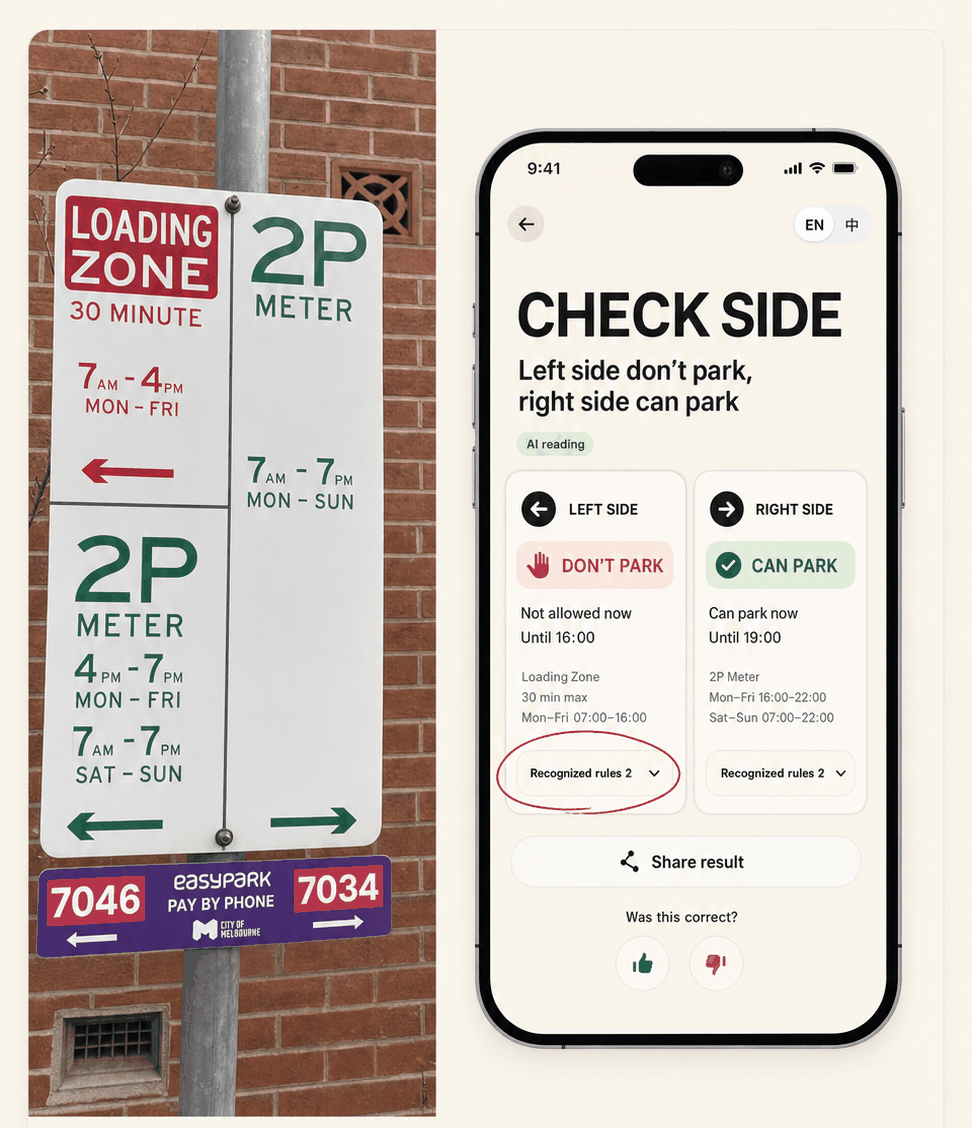
Read the whole pole
ParkingMate is built for new drivers, newcomers and anyone parking on an unfamiliar street. Take a photo in your browser or upload one from your camera roll. The app reads the panels, hours and arrows, then explains which signed rule applies at the current Melbourne time.
How to read the example
The sign in the product example points to two sets of conditions. During the weekday loading-zone window, the left arrow points to the active loading zone. The right arrow points to a separate metered area. ParkingMate shows a Check side result so drivers can match the answer to where they’re standing. They can expand the recognized rules to check the model’s reading against the sign.
Designed for a quick decision
The result leads with one of four states, from Safe or Check side to Don’t park or Uncertain. It puts the explanation and recognized rules underneath. When the photo is hard to read, an Uncertain result gives the driver a reason to look again or retake it. Drivers can try a scan from the website before creating an account.
How I built it
I built the mobile scan flow, bilingual interface, vision-model integration, account access and Stripe billing. The model returns structured facts per signed direction. The backend validates those facts and calculates any supported departure or recheck time. I tested cases with opposing arrows, unreadable panels and daylight-saving boundaries, including a case where one direction remains interpretable when the other is unclear.
The app’s result is a reading of the photographed sign. Drivers still need to check the posted signs and road markings at the spot.